
A real person answers
No phone tree. A treatment specialist listens to what's going on, for you or someone you're worried about, without judgment and without rushing.
SmarterRecovery connects people to licensed drug and alcohol treatment centers across the United States, 24 hours a day. In 2023, 48.5 million Americans aged 12 or older had a substance use disorder, according to SAMHSA's National Survey on Drug Use and Health, while CDC data recorded 105,007 drug overdose deaths that year. Our specialists assess your situation, verify your insurance benefits under the federal parity law, and place you in detox, residential, or outpatient care — often within 24 to 48 hours. The call is free and confidential.
Not ready to talk yet? Answer four quick questions and we'll call you.
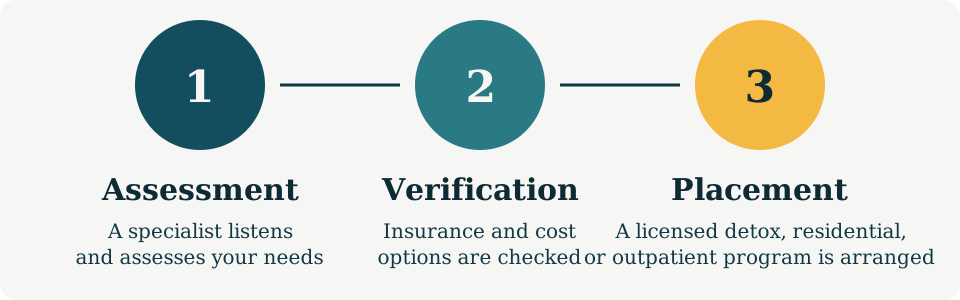
What happens when you call
No phone tree. A treatment specialist listens to what's going on, for you or someone you're worried about, without judgment and without rushing.
Where you are, what you can pay or what your insurance covers, any medical needs, and what kind of program would actually fit your life and your schedule.
Often the same day, sometimes within hours. If nothing in our network is the right fit, we tell you that and point you somewhere better.
What we help with
Pick what fits closest. Each page explains what treatment looks like, how long it takes, and how people pay for it.
The most common reason people call. Withdrawal can be dangerous; detox is often step one.
Medication-assisted treatment with buprenorphine or methadone is proven to cut overdose risk.
Oxycodone, hydrocodone, and others. Often starts with a legitimate prescription.
Xanax, Klonopin, Valium. Never stop suddenly; a medically supervised taper is essential.
Behavioral therapies like contingency management have the strongest evidence.
Intense cravings and crash cycles respond well to structured residential or IOP programs.
Daily use that's hard to stop is real and treatable, usually through outpatient counseling.
Depression, anxiety, PTSD, or bipolar alongside substance use. Both need treating together.
Levels of care
Select a stage to see what it involves, how long it usually lasts, and who it fits.
How we vet programs
Addiction treatment has a bad-actor problem: patient brokers, "free flights" that end in a bill, programs with no medical staff. We don't refer to anyone who hasn't cleared every item on this list, and we re-check annually.
Read our full standardsPaying for treatment
Federal parity law requires most health plans to cover addiction treatment the same way they cover any other medical condition. Medicaid covers it in every state. Tell us who your carrier is and we'll check your actual benefits while you're on the phone.
No insurance? Ask us anyway. Many programs have sliding-scale fees, state-funded beds, or payment plans, and we know which ones. Nobody gets turned away from a phone call.
Guides
Start with the guides people read most, or pick a topic. Every guide is free to read, and none of them ask for your information.
Treatment near you
Search your city or state. Each location page covers programs, costs, and what's realistic nearby.
No match yet. Call or text us and we'll find the closest options, or browse every state.
Download free printable PDF study materials and historical recovery literature for personal recovery, meeting groups, and sponsorship.
The foundational principles of personal recovery. Print-ready 1-page reference.
Guidelines for meeting autonomy, unity, self-support, and anonymity.
The Ninth Step Promises from pages 83–84 of the Big Book.
Complete text of Alcoholics Anonymous including the 164 basic text pages.
Common questions
Yes. Calling us, answering our questions, and getting connected to a program costs you nothing. Our service is funded by the licensed treatment providers in our network. You'll never receive a bill from SmarterRecovery.
A trained treatment specialist working for one of our vetted partner providers. They're not salespeople reading a script. Many are in recovery themselves. If they can't help with your specific situation, they'll say so and tell you who can.
No. Your call and any information you share stay between you and the provider who helps you. Treatment programs are bound by federal confidentiality rules (42 CFR Part 2 and HIPAA) that are stricter than ordinary medical privacy.
Detox and residential admissions often happen within 24 to 48 hours, sometimes the same day if a bed is open and insurance is confirmed. Outpatient programs usually start within a week. If you're in a medical emergency, call 911 first.
Most plans do, because federal law requires it. What varies is the deductible, copay, and which levels of care are approved. We verify your specific benefits before anything is scheduled, so there are no surprises.
Call or text anyway. We can talk through how to approach the conversation, whether a professional intervention makes sense, and what options exist in your state. You don't have to have them convinced before you pick up the phone.
Sources
If you or someone you love is in immediate danger, call 911. For a mental health or substance use crisis, call or text 988 any time, day or night. Information on this page is educational and is not medical advice.
The next step is smaller than it feels. One call, ten minutes, and you'll know what your options actually are.
Licensed detox, residential, and outpatient programs serving Beckley and Raleigh County. Talk to a specialist who knows the local options and what WV Medicaid and private plans cover, or answer four questions and we'll call you.
Quick answer
If you're looking for addiction treatment in Beckley, WV, you have three realistic paths: outpatient programs in Raleigh County, residential treatment within a few hours' drive (Charleston, Huntington, Princeton, or out of state), or medical detox first if alcohol, benzodiazepines, or heavy opioid use is involved. West Virginia Medicaid covers substance use treatment and most private plans do too. Call or text (800) 653-9376 to find which programs near Beckley have openings this week.
Beckley is the largest town in southern West Virginia, and it sits in a region that has been hit harder by the opioid crisis than almost anywhere in the country. West Virginia has reported the highest drug overdose death rate in the U.S. for most of the last decade. The upside of that grim statistic is that the state has built out more treatment capacity than its size would suggest, and Beckley's location at the I-64 and I-77 interchange puts a lot of it within reach.
Here's what the levels of care actually look like for someone in Raleigh County:
| Level of care | What it is | Near Beckley | Typical length |
|---|---|---|---|
| Medical detox | 24-hour medical supervision while substances clear the body | Hospital-based and freestanding detox in the region; Charleston and Huntington have the most beds | 3 to 7 days |
| Residential (inpatient) | Live at the facility with daily therapy and structure | Several licensed programs within 1 to 2 hours; out-of-state options for people who want distance | 28 to 90 days |
| Partial hospitalization (PHP) | 5 to 6 hours of treatment a day, sleep at home or in sober housing | Limited in Raleigh County; more common in Charleston | 2 to 6 weeks |
| Intensive outpatient (IOP) | About 3 hours a day, 3 to 5 days a week, around work | Available in and around Beckley | 8 to 12 weeks |
| Medication-assisted treatment | Buprenorphine, methadone, or naltrexone with counseling | Multiple providers in the Beckley area | Ongoing |
| Standard outpatient | Weekly individual or group counseling | Widely available locally, including telehealth | Ongoing |
Which one is right depends on three things: what substance is involved, how heavy the use has been, and how much structure the person needs to stay safe in the first weeks. That's the conversation we have with you on the phone.
Tell us what's happening. We'll tell you honestly what makes sense for Beckley, and what's open right now.
For alcohol and benzodiazepines, almost always yes if use has been daily and heavy. Withdrawal from either can cause seizures, and alcohol withdrawal can be fatal without medical care. For opioids, detox is miserable but rarely life-threatening; the bigger risk is relapse afterward with a lowered tolerance, which is why medication-assisted treatment matters so much in this region. For stimulants like methamphetamine and cocaine, there's no medical detox as such, but a supervised setting helps with the crash.
If the person is shaking, sweating heavily, confused, or has a history of withdrawal seizures, don't wait for a program to call back. Go to the emergency department at Raleigh General Hospital or call 911, then call or text us from there.
West Virginia expanded Medicaid in 2014, and WV Medicaid covers detox, residential, and outpatient substance use treatment. If you have a Medicaid card, or think you might qualify, you likely have more options than you expect. Private insurance through an employer is required by federal parity law to cover addiction treatment comparably to other medical care. Deductibles vary; we check them before anything is scheduled.
People in Beckley ask this more than almost any other question. There's no universally right answer, so here's the honest trade-off:
A common pattern that works well: travel for detox and residential, then come back to Beckley for IOP and long-term outpatient. We can arrange both halves.
Recovery mostly happens after rehab, in ordinary weeks. Beckley has an active recovery community for a town its size: regular AA and NA meetings throughout the week, peer recovery coaching through state-funded programs, and local churches and community groups that host open meetings. Ask any program you consider for its specific aftercare plan, and ask us to make sure that plan includes real names and addresses in Raleigh County, not a brochure.
Beckley has strong outpatient, IOP, and medication-assisted treatment options. For residential and medical detox, most people go to programs within one to two hours, most commonly toward Charleston or Huntington, or out of state. We'll tell you exactly what's open when you call.
It varies week to week. Detox beds in the region often open within 24 to 72 hours. Residential can be same-week or two to three weeks depending on the program and insurance. If speed matters, tell us, and we'll prioritize programs with immediate openings.
West Virginia does have an involuntary commitment process for substance use in limited circumstances, but it's rarely the best path. Call or text us to talk through how to approach a loved one who's refusing help; there are better tools than the courts in most cases.
Yes, subject to medical necessity criteria. Medicaid managed care plans in West Virginia cover detox, residential, PHP, IOP, outpatient, and medication-assisted treatment. We verify coverage before you commit.
Alcohol is the most common reason people call us, and one of the few substances where stopping on your own can be medically dangerous. Here's how treatment works, what it costs, and how to tell when it's time.
Quick answer
Alcohol addiction is treated in stages: medically supervised detox (3 to 7 days) if drinking has been daily and heavy, then residential or intensive outpatient treatment using therapies like CBT, then long-term outpatient care and support groups. Three FDA-approved medications (naltrexone, acamprosate, and disulfiram) reduce cravings and relapse. Most insurance plans cover it. Call or text (800) 653-9376 to find a program with openings.
| Medical name | Alcohol use disorder (AUD), rated mild, moderate, or severe |
|---|---|
| Is detox needed? | Often, yes. Alcohol withdrawal can cause seizures and delirium tremens, which can be fatal without medical care. |
| Typical treatment length | 30 to 90 days of structured treatment, followed by ongoing outpatient care and support |
| FDA-approved medications | Naltrexone, acamprosate, disulfiram |
| Insurance coverage | Required under federal parity law for most plans; Medicaid covers in all states |
| Can it be treated outpatient? | Yes, for mild to moderate AUD without withdrawal risk. Severe AUD usually starts with detox. |
Alcohol use disorder isn't defined by how much someone drinks. It's defined by what drinking does to their life and what happens when they try to stop. The signs cluster into two groups.
Answer honestly, for yourself or for the person you're worried about. Two or more "yes" answers are a reason to talk to someone.
Nothing here is stored or sent anywhere. It's just for you.
This is not a diagnosis. Only a clinician can diagnose alcohol use disorder. If you answered yes to the morning drinking or shaking question, please don't stop drinking abruptly without medical supervision.
Withdrawal follows a fairly predictable arc. In a medical detox, symptoms are managed with medications (usually benzodiazepines on a taper, plus fluids, thiamine, and monitoring) so the person stays safe and reasonably comfortable.
One call tells you what's available tonight, what your insurance covers, and how to get there.
After detox (or instead of it, for milder cases), treatment is about learning to live without drinking and repairing what drinking damaged. The levels below aren't a ladder everyone climbs; most people use two or three of them.
| Option | Setting | Length | Best fit |
|---|---|---|---|
| Medical detox | 24-hour medical care | 3 to 7 days | Daily heavy drinking, any withdrawal history |
| Residential rehab | Live at the facility | 28 to 90 days | Needs distance from the drinking environment; prior relapses |
| Partial hospitalization (PHP) | Day program, 5 to 6 hours | 2 to 6 weeks | Step-down from residential with stable housing |
| Intensive outpatient (IOP) | 3 hours, 3 to 5 days a week | 8 to 12 weeks | Working, parenting, moderate AUD |
| Outpatient counseling | Weekly sessions | Ongoing | Mild AUD, or maintenance after higher levels |
| Support groups | AA, SMART Recovery, others | Ongoing | Everyone, alongside any of the above |
The therapies with the strongest evidence for alcohol use disorder are cognitive behavioral therapy (CBT), motivational enhancement therapy, and, for couples and families, behavioral couples therapy. Good programs use these alongside medication, not instead of it.
Three medications are FDA-approved for alcohol use disorder. They're underused: a small fraction of people who could benefit ever get a prescription. Ask about them.
None of these are a cure on their own, and none are habit-forming. They make the work of staying sober easier, which is the point.
If you're reading this for a spouse, a parent, an adult child, or a friend, you're in the majority of people who contact us. A few things that help:
If they refuse, you can still call. We'll talk through options including professional interventions and how to keep the door open without wrecking yourself in the meantime.
Detox is 3 to 7 days. Residential is usually 28 to 90 days. Research consistently shows better outcomes with at least 90 days of total treatment across levels of care, which often means a shorter residential stay followed by IOP and outpatient. Ongoing support after that is open-ended.
For light or occasional drinkers, stopping usually causes no medical issue. For anyone drinking heavily every day, or with any history of withdrawal symptoms, home detox is dangerous because seizures and delirium tremens can occur without warning. Medical detox is the safe option and is covered by insurance.
For moderate to severe alcohol use disorder, abstinence has the best track record. For milder cases, some clinicians work toward reduced drinking first. Either way, that's a decision to make with a professional, not a reason to delay the call.
Treatment records are protected by federal law (42 CFR Part 2) with stricter privacy than ordinary medical records. The Family and Medical Leave Act (FMLA) protects eligible employees who take leave for treatment, and the ADA protects people in recovery from discrimination.
With insurance, out-of-pocket costs are often limited to your deductible and copays, since federal parity law requires coverage. Without insurance, costs vary widely, from state-funded programs at little or no cost to private residential programs in the tens of thousands. We verify your specific numbers before anything is scheduled.